The Roots of Crime in Jamaica - the
Crisis in the Rural Economy
From the Homecoming Lecture delivered by Professor
Don Robotham, CUNY Graduate Centre Homecoming Honouree
 |
I want to use this occasion to discuss
an issue which continues to afflict our society, which is
the issue of crime. In doing so, it is not my intention to
enter into the current heated debates about the measures
to be adopted to address this huge problem in the short
term. I would only urge great caution in how we proceed:
we must not lose sight of the fact that short-term
measures have very real medium- and long-term
consequences. The broad social and political consequences
of draconian measures taken in desperation today are
surely not going to disappear tomorrow or the many days,
months, and, indeed,years after tomorrow.
I also wish to highlight the very important research which
scholars at The University of the West Indies continue to
conduct on the crime issue. There is the foundational work
of Professor Tony Harriott, especially his recent work
stressing the importance of effective investigation of
crimes. There is also the work which Horace Levy, Dr.
Elizabeth Ward and Deanna Ashley have done on Peace
Management and Violence Prevention. This work clearly sets
out in some detail methods which can be used to intervene
at crucial points in the lives of young people to reduce
the likelihood of their turn to crime.
I also want to mention the recent work of Professor Wayne
McLaughlin to set up a forensic science program. This is a
highly important initiative which will make a very
practical contribution to addressing the crime issue.
Finally, I wish to point outthe significance of the
brilliant work by Dr. Herbert Gayle. Unlike the work
byothers, this is principally qualitative work using
anthropological methods.
To me, one of the great values of this work is that it
offers us profound insights into the process by which a
young person sets out on the road to crime. When read
together with the autobiographies of offenders (which
exist) we can see in some detail and at a very personal
level, how an otherwise very normal young man at a certain
point and under specific sets of social circumstances,
takes a turn to crime which others around him might or
might not.
This detailed work offers us deep insights as to how the
process works and provides us with important and
invaluable clues as to how to intervene to reduce the
likelihood of this wrong turn.
There are many other scholars at The UWI who have been
labouring in this vineyard for years – Professor
Denise Eldemire-Shearer, for example. I hope they will
forgive me if I don’t mention them all. I only choose
those above as the work with which I am most familiar and
whose findings seem to me to be immediately useful.
This many-sided and high quality research is not
recognized enough by the wider society – the canard that
UWI is not contributing to Jamaican and Caribbean society
continues to hold sway in some surprising quarters. It is
manifestly false and we have to redouble our efforts to
ensure that the society becomes more aware of this work.
What is true, however, is that work rarely finds its way
into public policy. Something is profoundly wrong when
this highly relevant body of research and public policy
simply exists side-by-side without the first having much
impact on the second. Indeed, it is worth researching the
policymaking process in Jamaica as an issue in itself – we
need to understand what the bottlenecks are and how to
remove them.
Instead of speaking to the immediate issues, I want to
look at what I suggest to be one the underlying causes of
our crime problem: the crisis in the rural economy.
I want to begin by reviewing the data on the crime prone
group in our society. This is the population in the
15-29 age group—particularly men, who are responsible for
at least 80% of all the crimes committed, homicides in
particular. As we know, but is persistently
forgotten, Jamaica has had a low birth rate for some time
now. The vision that many perversely cling to, of a
society in which children are being produced and strewn
about at an alarmingly high rate, has not
corresponded to reality for at least 10 years.
This low birth rate is the reason why the Jamaica
population has not budged much—remaining at roughly 2.7
million persons over the decade. Indeed, one consequence
of this declining birth rate is that increasingly we are
facing all the problems of aging societies—pressures for
greater health care expenditures on the elderly, a greater
incidence of chronic diseases, labour force problems,
different patterns of dependency and so forth.
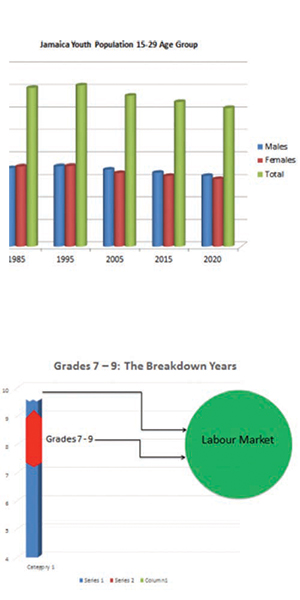 |
The result of this falling birth rate is apparent in the
following table: The 15-29 age group rose to a peak in
1995 but has steadily declined thereafter. By 2020,
according to my projections there should be about 100,000
fewer persons in that age group than existed in the peak
year more than 20 years ago. Both males and females
declined, with the decline in females slightly higher than
that of males. Based on these data, it would have been
logical to project that our crime rate, including our
homicide rate, would have gone down. But instead the rates
have shot up. What this tells us is that there is no
relief to be sought in these purely demographic type
shifts. Deeper forces are at work in, in effect, to
intensify the pressures on young people to commit more
crimes. What would some of these pressures be?
Firstly, this has to do with problems in our education
system and in our labour market. As far as our education
system is concerned, both our GSAT and CXC results as well
as the work of Herbert Gayle and Elizabeth Ward suggest
that there aregrave problems at the 7-9 grade levels. I
call these the breakdown years: If we carefully analyze
the performance of our children in the annual GSAT exams
and compare the performance at CXC levels we will see that
there is a clear relapse in the education system between
the two levels. The data that we have suggests that, if we
could sustain the levels of performance achieved in
English and Mathematics at the GSAT level, we could
achieve about a 15-20% improvement in our educational
quality at the point of graduation. Studies of individual
schools confirm this conclusion. It is clear that
there is a relapse in educational performance right after
the GSAT. It is as if the parents and the children having
made the supreme effort at GSAT (huge expenditures on
private lessons, other intense training, acute family
pressures) heave a sigh of relief feeling that their job
has been done and it is now up to the child and the high
school teacher to deliver the goods.
Rural schools have a particular problem in this regard. In
one case with which I am familiar, after GSAT, the
children go on from the primary school in the same
township to the local high school. Their performance in
the GSAT is weak but their performance at the CXC is truly
dismal. What is behind this? Here we come up on old
patterns of rural family socialization and political
economy. It is well-known that at around the age of 11/12
(and sometimes earlier) the child will often be given some
chickens or a goat of their own to look after. Boys may be
given some banks of yam to cultivate and to keep the
income as their own. They begin helping family members who
go to market or with other economic activities (‘ductor’
on a bus or sideman on a truck). In other words, the
children begin to enter the labour market during this
period in a haphazard fashion. Absenteeism grows, in
addition to all the problems of adolescence, affecting
boys in particular. We see it in the lamentations around
the behavioral problems of our children in this age group
on public transportation. The children leave school early
with limited literacy and numeracy and are unfit for
anything but unskilled general labour. This is a huge
problem, and as the work of Herbert Gayle and Elizabeth
Ward, Deanna Ashley and others shows, these are crucial
years in the turn to crime. Yet, again, we know from the
work of the Violence Prevention Alliance, it is perfectly
possible to develop effective programs to counter this
breakdown. Their “10-Point Plan for Violence Prevention”
is based on careful research and practical experience and
offers us simple but effective solutions to reduce the
problems in these breakdown years.
Here it is necessary to make a side commentary on early
childhood education. Sometimes it seems that this is
presented as a panacea for all the problems of our
education system. The thought seems to be that if one
could only fix the system at the point of entry then the
benefits would flow smoothly through to the rest of the
education system, up to the CXC level. This is an
illusion. Every level in the education system counts. For
many reasons, we cannot rely on the very important
improvements in early childhood to carry the burden of the
weakness of the system in the immediate post-GSAT years.
Those years are a problem in their own right and require
their own distinctive solutions. In fact, if I were to
single out a particular segment of the education system
for priority attention there is no doubt in my mind that
these breakdown years of grades 7-9 would be the prime
area of focus. If we focus more on these years and address
the difficulties that arise there it won’t solve
everything but will certainly take us to a place better
than where we are today. Again, one must ask the
question—why isn’t this work more applied by our
policymakers? What are the forces which are obstructing
their use?
As pointed out above, our children begin to enter the
labour market in significant numbers in these breakdown
years. An immediate consequence of this is the
relatively high youth unemployment rate which is in the
region of about 20%. But more important than the gross
unemployment rate is some characteristics of the
youth unemployed: about 45% of all youth unemployed are
long-term unemployed. Most striking of all, about 63% of
the long-term youth unemployed have never worked. However,
and this is most important, about 27% of them have 4 years
or more of high school education but no certification.
NO WORK EXPERIENCE
We should reflect on those data for a moment. What they
are saying is that, in the approximately 650,000 young
people in the 15-29 age groups, we have a large pool of
young people who have no experience of work whatsoever.
Large numbers of them have stopped looking for work
completely and have left the labour market altogether. It
is striking that STATIN labour market survey data for 2014
indicate that about 53% of those who are able to work but
not seeking, give as their reason thatthey “don’t want
work.” It is important to be cautious here and to
emphasize that they are NOT saying they “don’t want to
work.” This is not a statement about the general value
that they attach to work. It is a situational statement
which is highly contextual: I interpret it to mean that,
given existing low wage levels, especially for labour
market entry-level jobs (for example in the tourist
sector), remittances and other forms of family support,
the options of hustling legally and illegally, all things
considered, in the concrete circumstances of their life in
Jamaica, not working is the better option. Take some of
these same people out of this context— for example, by
migration—and their hitherto dormant work ethic somehow
blossoms!
However one interprets this, the more important point is
that thousands of our long-term unemployed youth who have
dropped out of the labour force have been in high school
for some years and do have some education but no
certification.
In other words, the situation is that a very large number
of our youth do not earn a regular income in the labour
market yet have had their aspirations raised by being
exposed to more education, however limited. This exposure
is of course greatlyincreased by social media and the
whole cell phone culture producing a combustible mixture
with which we are confronted every day. It is well known,
from the experience of Nigeria, for example, where high
levels of graduate unemployment have produced a
proliferation of cyber crimes which have severely harmed
that country’s international reputation, that this
combination of chronic youth unemployment and some
education is a formula for social disaster. Sadly, Jamaica
too has embarked on a comparable road. There is no doubt
that our case has important similarities to the Nigerian
one and that, apart from the lotto scamming which is the
obvious example, we are already facing an increase in
crimes— for example ATM password theft—which reflect a
higher level of education. Below is an excerpt from the
threatening letter written by extortionists in Manchester
and Clarendon and published in The Gleaner:
“If you feel the need to get the police involved or
private security to protect your business or fight this
proposal, feel free to do so, because if they apprehend
the subject that is sent to you, you (the owner, manager,
employee) will be killed and your family will be at high
risk of being murdered in the most gruesome way."
This is written in sophisticated (if somewhat wordy)
English using a complex sentence structure and pompous
vocabulary (“apprehend”) with all the punctuation properly
and carefully in place, almost as if it went through a
process of drafting, copy editing and redrafting. There is
even a slight touch of sardonic humor and irony—“feel free
to do so”—this is no hastily scribbled note from an
illiterate criminal. We are face-to-face with a writer who
understands how to deploy nuances of the English language
to evoke a particular emotional response from the reader
and who even takes a certain pride in showing off these
skills. The long and grammatically perfect threatening
sentence is clearly written by someone with at least a
tertiary education—my guess would be a graduate in the
Humanities since Social and Natural Science graduates are
not renowned for their prosewriting skills!
 |
THE RURAL ECONOMY
But these general problems of our youth population are
acutely intensified for the rural youth since we know from
many Surveys of Living Conditions that poverty is most
prevalent and deepest in the countryside, principally in
the hills in the interior of parishes such as St. Ann,
Hanover, Westmoreland, and St. James. This takes me to the
specifics of the situation in the rural economy. Here I
begin with some data setting out the decline in the
production of sugar and banana, the two crops which have
sustained the population for centuries. From a high of
over 400,000 tonnes in the 1960s, sugar production has
drastically declined to about 130,000 tonnes in 2014-2015.
It should be pointed out that, as others have done, that
from the 1960s this sugar problem was apparent, especially
to the principal investors Tate & Lyle. This is why they
took steps to sell out to the Shearer government before
1972. It was apparent then that the 400,000 tonnes crop
was won by bringing entirely unsuited lands into
cane production and that the high figure obscured the low
sugar cane yields which obtained.
It should also be noted that this collapse of sugar is not
peculiar to Jamaica: Puerto Rico, Cuba and the Dominican
Republic have also faced this problem which has wreaked
havoc with rural life throughout the entire region. Since
2002, Cuba has closed 71 of their 156 sugar mills and
taken 62% of the land hitherto devoted to sugar
cultivation (about 4 million acres), out of production.
The result is that employment in the sugar industry in
Cuba is reported to have declined substantially leaving
about 200,000 persons employed from approximately 500,000.
A similar problem applies to banana production in the
region. In Jamaica, this also fell dramatically up to
2006-2007. Since then there has been some limited recovery
but not enough to improve the lives of the people in the
parishes which traditionally depended on these crops for
their livelihoods. Again, it should be noted that the
decline of bananas is not peculiar to the
Caribbean—Honduras has also suffered from changes in this
sector: between 2003 and 2013, banana production declined
by 40% and there was a similar collapse in coffee
production. The crisis in the Honduran and Central
American countryside has been an important driver of the
extremely high homicide rates (67 per 100,000) in those
countries and the high rate of external migration to the
United States.
It should be recalled that Arthur Lewis, in his famous
article on ‘Economic Development with Unlimited Supplies
of Labour’ published as long ago as 1954, anticipated this
problem of the crisis of the rural economy and its chronic
‘surplus labour’ problem. In other words, Lewis saw
clearly that the postwar Caribbean rural economy was not
viable and that political independence would be
meaningless without a transformation in this situation.
Looking back, it seems to me that the depth of this
problem was insufficiently grasped then by our
politicians, policy makers and the general public.
Lewis’ answer to the crisis was a program of tax holidays
to attract foreign investment into manufacturing which
would then produce for the export market. This, in his
view, would siphon off the excess labour from the
countryside and also keep urban wage levels fairly low,
providing even more of an incentive for inward
manufacturing investment. Parts of this Lewis policy were
followed in both Jamaica and Puerto Rico but without the
export-led development thrust. It was left to the newly
industrializing countries of Southeast and East Asia to
pursue the Lewis model in its fullness and to its
ultimately successful conclusion.
But, and this is the point, the Lewis model didn’t really
speak to the issue of revitalizing the rural economy so
much as it did tothe creation of a new urban economy based
on manufacturing. In his model, the rural economy remained
very much a residual and it is not at all clear how it
would have been modernized, if at all, or whether it would
simply linger on as a diminished labour reserve appendage
for urban manufacturing where the real economic action
would be. It’s worth noting that in South Korea, often
cited as the model Lewis development experience, the
problem of rural poverty and stagnation and a large food
import bill continued to plague the country even into the
1980s when urban industrialization had already become
considerably advanced. What this suggests is that the
problem of revitalizing the economy in the countryside is
a very difficult one to resolve, even under the most
advantageous circumstances of rapid industrialization.
The impact of the decline of the old export crops is
clear. What of domestic agriculture? A look at Jamaican
domestic crop production (yam, vegetables, condiments)
shows that this has either maintained the same level of
output or declined somewhat since a high in 1996. There
are a couple of points worth noting here: First, in
general, there has been no expansion of domestic
production to take up the slack following the decline of
the traditional export crops. Further, it is striking that
domestic agricultural production is concentrated in three
parishes: St. Elizabeth, Manchester and Trelawny.
Parishes such as Hanover, St. James and Westmoreland (3%,
4%, 7%) produce relatively small amounts. Very clearly,
domestic crop production is still principally oriented to
the-old internal marketing system going back to the 18th
century and is in almost complete disconnect, for example,
from the tourist sector. In a more balanced process
of economic transformation, the development of a new
sector such as tourism would be integrated with others and
indeed, provide a new expanding market for the commodities
being produced in the countryside. But such has not been
the case.
On the contrary, if one looks at the expansion of tourism,
the disconnect between tourism and the food producing
sector becomes even more apparent. From a low of 35% of
export earnings, tourism is now at about 50% (the sharp
dip reflects the 2008 Great Recession). Despite that
15% points growth in tourism food production has basically
remained flat or trended down somewhat. All indications
are that tourism revenues will continue to grow in the
future as our visitor arrivals increase steadily.
However, tourism is on the coast where the glittering new
hotels are being built. There is no glitter in the hills
where poverty and severe economic hardship reign. A
profound, and one could even say, brutal spatial
re-orientation of our centuries old rural economy, is
complete. The notorious ‘plantation economy’ of the
Caribbean, is no more. A largely coastal economy almost
completely dependent on tourism and services has replaced
it.
From the West End and Seven Mile Beach in Negril on the
left, to Hopewell on the right, the coast is alight with
one hotel after another. When one looks at the old sugar
plains of Westmoreland and St. James and the banana lands
of Hanover, the picture is one of darkness and
abandonment.
One has to be careful not to draw too straight a line from
the economy to crime—it doesn’t of course work quite like
that. Nonetheless it is striking that, outside of the
urban centers, it is precisely in the abandoned
parishes of Hanover, Westmoreland, St James and Clarendon,
that we find the rural murder rate shooting up. So far for
2017, the murder rate in the above three parishes has
increased from what it was in 2016: from 1 to 12 in
Hanover; from 6 to 11 in Westmoreland; and from 5 to 12 in
St James. My expectation is that this will continue to be
the case until we can find a way to restore economic
viability to the hills of rural Jamaica.
 |
SOME SOLUTIONS
The revitalization and transformation of our collapsing
rural economy is precisely the challenge facing us. In
that regard, let us take a brief look at some initiatives
which have been taking place recently in rural economic
transformation. These are examples of small scale tourism
development in the countryside, far away from the luxury
villas and mass tourism allinclusives of sun, sea and
sand.
My approach is to look at examples ofwhat is actually
taking place and to see what can be learned from this
rather than to prescribe abstractly and from the top down.
Although there are a wide range of new economic activities
occurring in the hills, I identify two models: the first
is the single entrepreneur model heavily dependent on
Airbnb. The second is a community tourism model which
works closely with a group of US colleges.
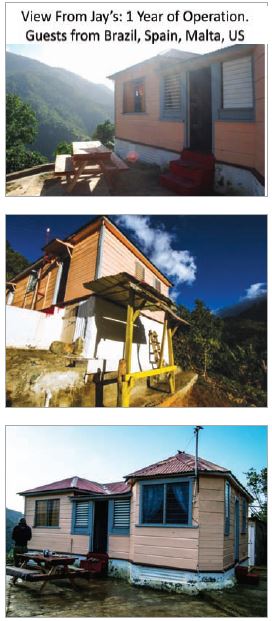
The first case is Jay’s Guest House located at Hagley Gap
on the St. Andrew/St. Thomas border.
Jay’s is a family business run by Aden Jackson a young 25
year old graduate of Mico who teaches at the local school
and who was born and raised in the area. He has a staff
who are largely members of his immediate family.
The business has been in operation for one year and gets
visitors from Germany, Brazil, Canada, Spain, Malta,
Bulgaria and the United States. Aden markets Jay’s through
Airbnb which, according to the Minister of Tourism
has over 1,000 Jamaicanproperties on site bringing in
about 32,000 tourists, many of whom stay in urban inner
city neighborhoods such as Trench Town, drawn by the long
history of musical culture.
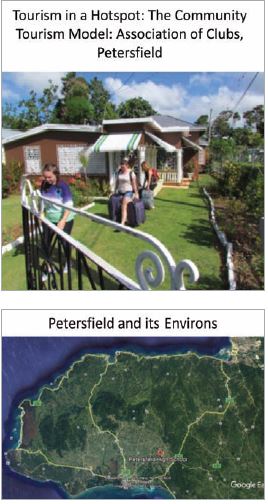
This takes us to the second model: the Community Tourism
Model operated by the Association of Clubs in Petersfield,
Westmoreland. One of the most remarkable things about this
model is that it is located in an area formally designated
a high crime hotspot by the police. Yet, they have been
operating since 2001 without a single incident or crime
against any visitor.
This model does not market through Airbnb but instead
works with AmizadeGlobal Service-Learning, an American
operation which organizes study abroad programs with major
US universities. This year, the Association of Clubs of
Petersfield will have visits from 15 universities,
including the University of Pittsburgh, Cornell and Rice,
with between 10-15 students coming in each group, many
being repeats.
Unlike the case of Jay’s Guest House, these students are
required to live in the homes of members of the local
community and to make tangible contributions to
Petersfield community life. They have helped to construct
rooms at the local school, build a local bus stop shed,
improve the local school library and generallyhelped to
improve the conditions of life of local citizens. All of
this ensures that the benefits of the visits are shared
widely in the community and local people have a vested
interest in ensuring that the visitors are protected and
will want to return.
The organizer of this venture, Mathias Brown CD, is a
highly experienced Frome sugar worker cooperative leader
with verydeep roots in the Georges Plain area and widely
known throughout much of Westmoreland. For Mathias, apart
again from wifi and proper plumbing, the most important
factor in the Petersfield success is security. He stresses
that this is the principal concern of the College
representatives and this is the most crucial area in which
constant vigilance is essential. It should be noted in
this regard, that the Association of Clubs are not naïve
about the presence of criminals in the community but
take appropriate steps to ensure that visitors remain safe
and secure. Without the broad distribution of benefits and
the deep knowledge of the community, they would not have
been able to have the success which they have achieved.
This model of community tourism which taps into the US
college market is not unique—Dr. Erna Brodber has operated
a facility with some similarities to this one but with a
stronger academic and cultural program stressing the
African-Jamaican heritage in particular. But, the
Association of Clubs are clear that theirs is principally
a business however and they therefore combine community
development work with standard tourism activities such as
organized trips to resort areas such as Negril in which
students partake of very traditional tourist type
activities.
CONCLUSIONS
What conclusions can we draw from all of this? Below is a
photo of Aden Jackson, the operator of Jay's. Compare him
to a young man from the hills around Lucea recently
charged with multiple murders.
Aden is 25 years old and the young man is 22. Both are
from the hills and both probably share many experiences in
common while growing up. At some point, the youth from
Hanover made a wrong turn. What caused it? How can we
avoid that going forward? Which one is to be the futureof
Jamaica going forward? Can we replicate the examples from
Petersfield and Hagley Gap in the Hanover hills?
There is certainly no shortage of a cultural heritage of
wider interest to all: this is the area of three important
slave revolts—at Argyle and Golden Grove in 1824 and Sam
Sharpe’s revolt in 1831-32. The area is alsoone of
settlement of post-emancipation Yoruba and Kongo people—a
result of the interdiction of the Slave Trade by the Royal
Navy. In terms of more recent history, Blenheim—the
birthplace of Alexander Bustamante is in the same general
region. There also were Portuguese settlers in the region
and not far away in Westmoreland is the old German
settlement at Seaford Town. There are therefore many
opportunities to develop a more culturally oriented
tourism.
To pursue such opportunities requires us to take a new
approach. First, it should be clear that we need a
transformation and revitalization of the rural economy. It
is not enough to study squatter settlements in tourist
areas which arise especially in the hotel construction
phase. More and better housing for hotel workers in
tourist towns is key but does not answer the questions
arising from the crisis of rural life.
Equally, while the macro approach to the economy has been
vital and we have made fundamental progress in that area,
now is the time to move beyond the purely macro GDP
approach. First of all the issue is not just GDP growth
but the quality of growth: who benefits, is it inclusive,
sustainable and responsible environmentally? The most
recent data on economic inequality in Jamaica done by the
IMF showed a Gini coefficient of .59. That is an
astonishingly high level of inequality which is socially
fatal, especially in a small society like ours. Further,
we need to take a more ‘meso’ approach to the economy and
look behind the gross metrics of national income accounts.
Careful studies of regional economies on the ground at the
parish level are urgently needed. It’s vital to remember
that there is no single solution to our rural crisis—
there are and will be many approaches and many models.
We have to give room for them all and not strive for an
artificial standardization of any single approach. Above
all, we need better and more detailed data, especially
with respect to our labour force and living conditions at
the local levels. The University of the West Indies and
our national and local political representatives are
well-placed to conduct this work. And we must ensure, as
we proceed with the research, that the lessons for policy
are incorporated into practical programs of reform for the
lasting benefit of the Jamaican people.
NOTES & ACKNOWLEDGEMENTS
The data and charts in this paper were kindly made
available by a number of persons. I thank Elizabeth Ward
and the Violence Prevention Alliance, Horace Levy and the
Peace Management Initiative, STATIN and officers from the
Ministry of Agriculture, in particular, Sandor Pike,
Raymond Mattis and Sharlene N. Findley. I am particularly
grateful to Aden Jackson of Jay’s Guest House, Hagley Gap
and Mathias Brown from the Association of Clubs,
Petersfield for permission to use their photographs and
for their discussions of their pioneering work. I have
benefitted immensely from the wisdom of Professor
Mojubaolu Okome who introduced me to the relevant material
on crime and graduate unemployment in Nigeria. Arnold
Bertram and I have spent years discussing these ideas for
many of which he can rightly claim paternity.
|